How Bandcizer works
A two-part capacitive sensor attaches magnetically to the resistance band and measures deformation at 20Hz — force, timing, and quality for every rep. The app guides the patient. The dashboard shows the PT. Three components, one clinical workflow.
From prescription to recovery
See the Bandcizer workflow in 2 minutes
How It Works
Three simple steps to objective recovery data.
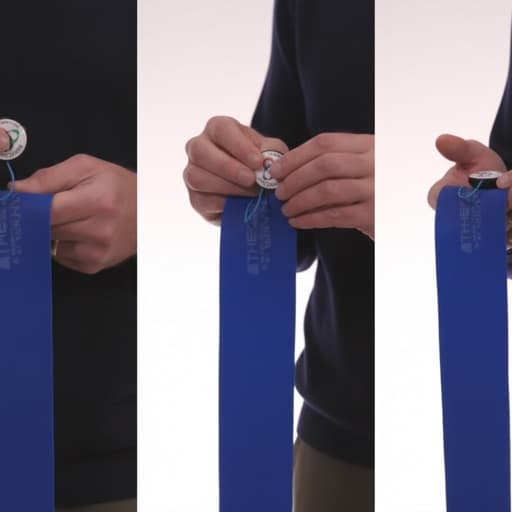
Attach
Place the two sensor halves on either side of the band. A built-in magnet holds them together. Works with any flat resistance band.
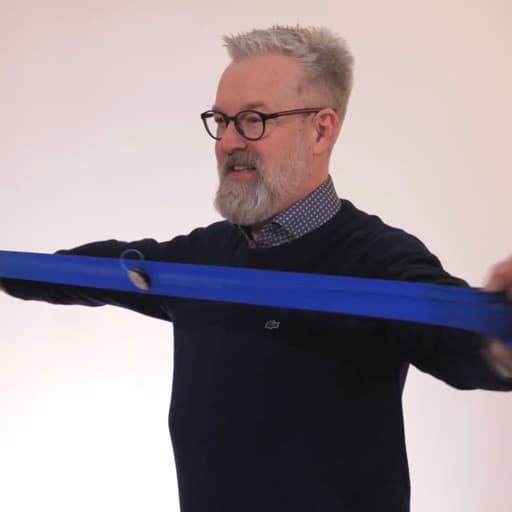
Train
Patient follows the app's real-time guidance for tempo and repetitions.

Review
Access objective compliance data instantly on the clinical dashboard.
The tempo problem nobody talks about
Your patients complete their prescribed reps. Every single one. But a 2024 study — using Bandcizer's own sensor to measure — found that actual time under tension dropped to 53% of prescribed levels within weeks. Even in supervised sessions.
They did the exercise. They just did it too fast. The eccentric phase gets rushed. The isometric hold gets skipped. The training stimulus — the thing that actually drives recovery — is cut nearly in half. And neither the patient nor the PT knows it's happening.
“Patients completed their reps but cut time under tension by 21–47% below prescription. They thought they were compliant. The sensor showed they weren't.”
Prescribe the tempo. We'll guide them through it.
The PT sets the tempo when prescribing an exercise — for example, 3-2-3: three seconds eccentric, two seconds isometric, three seconds concentric. The app's built-in tempo guide paces the patient through each phase of every rep.
Stretch (Eccentric)
Audio and visual cues count down the controlled lengthening phase. The patient hears and sees exactly how long to stretch the band.
Hold (Isometric)
A distinct tone signals “hold here” for the prescribed duration. No guessing when to transition.
Release (Concentric)
A final cue paces the controlled shortening. Or, for explosive protocols, a single “go” burst — the sensor measures the actual speed.
The patient follows the rhythm. The sensor measures what actually happened.
Other apps guide. Only Bandcizer verifies.
Every fitness app can prescribe exercises. Some can even guide tempo with timers. But no other system closes the loop by measuring whether the patient actually followed the prescribed tempo.
After every session, the PT sees:
Actual vs. prescribed TUT per phase, per rep
Tempo adherence score trending over weeks
Phase-specific patterns — "this patient consistently rushes the eccentric"
Software alone can prescribe and guide. But verifying actual force, time under tension, and tempo per phase per rep requires a physical sensor on the band. That's the moat.
Multi-Level Adherence Analysis
100% session attendance doesn't mean 100% compliance. Patients who show up for every session may still rush through exercises, skip sets, or cut their time under tension in half — and manual diaries won't catch it. Bandcizer breaks adherence into three nested levels, so the therapist sees the full picture at a glance.
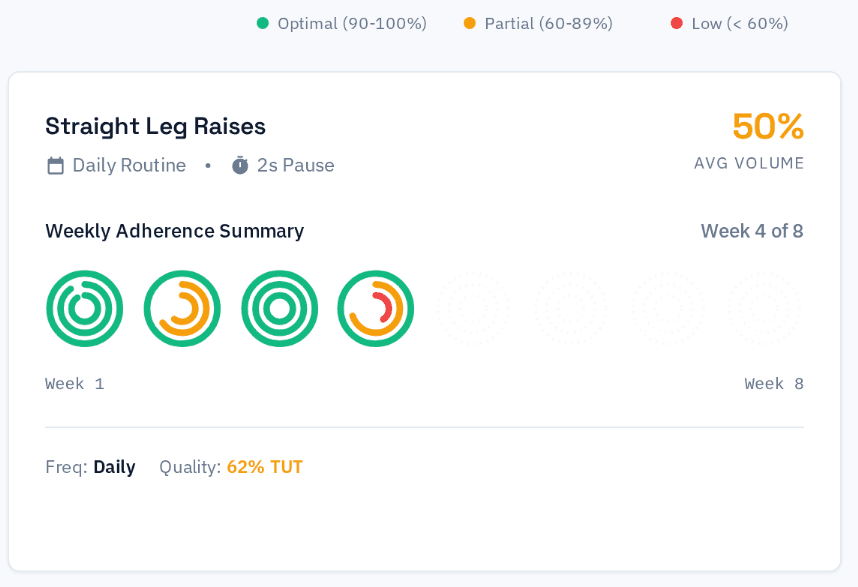
Outer Ring — Session Adherence
Did they show up? A session is counted as attended when the sensor records at least one repetition. Most systems stop at this number, which hides everything beneath it.
Middle Ring — Volume Adherence
Did they do the work? Compare the actual sets and repetitions completed with the prescription. A patient who adheres to the programme 100% might only complete 82% of their prescribed sets, with volume dropping in later weeks as motivation fades.
Inner Ring — Time Under Tension
Did they get the physiological dose? Did they receive the physiological dose? This is the most critical metric. Even if the required number of repetitions is completed, rushing them can reduce the actual training stimulus by half. The sensor measures time under tension in real time and compares it to the prescribed tempo, revealing the true dose delivered to the tissue.
A patient may appear to be fully compliant while actually receiving less than 40% of their prescribed physiological dose. The three-ring view reveals this discrepancy before it undermines recovery.
Supports any tempo prescription
The PT prescribes any combination. The app adapts the metronome. The sensor measures the result.
| Protocol | Format | Example |
|---|---|---|
| Standard 3-phase | Eccentric – Hold – Concentric | 3-2-3 |
| No isometric hold | Eccentric – Concentric | 4-0-2 |
| Explosive concentric | Eccentric – Hold – Fast | 3-1-X |
| Isometric only | Static hold | 0-30-0 |
| Emphasis eccentric (tendon rehab) | Slow stretch | 6-1-2 |
Technical Specifications
Sensor capability breakdown
SAMPLING RATE
20 Hz
Capacitive measurement for precise deformation tracking.
FORCE RANGE
0–50 N
Works with any flat band. Calibrated for Theraband Latex Free.
BATTERY LIFE
40+ Hrs
Active training time. Rechargeable via USB-C.
CONNECTIVITY
BLE 4.0
Instant, reliable app pairing.
Ready to upgrade your clinic?
Join physiotherapists across the Nordics using objective data to drive better patient outcomes.